
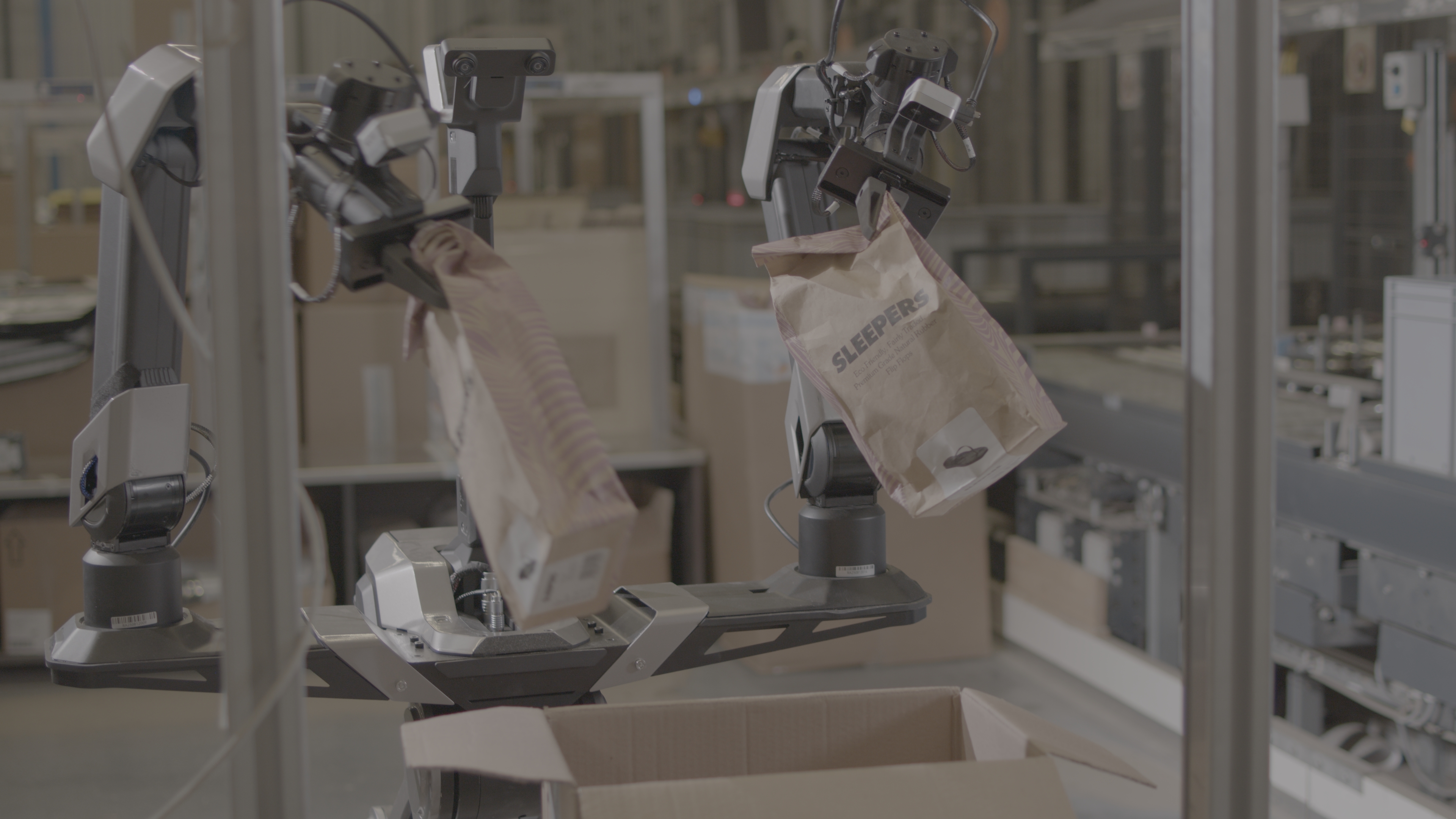
Warehouse tasks you can automate with AI robots
Traditional automation handles a narrow set of tasks. Rigid programming limits what robots do. End-to-end AI changes this. AI robots learn new tasks through demonstration. They adapt to variation. They handle complexity that traditional systems cannot.
This article covers three categories of warehouse tasks that AI robots now automate: order picking, packaging, and value added services.
Order picking: the largest opportunity
Order picking consumes 50% or more of warehouse labor hours. Traditional automation addresses only a fraction of picking tasks. Fixed grippers and scripted motions fail when products vary in size, shape, or packaging.
AI robots handle variation. The same robot picks pouches, boxes, bottles, and bags. No retooling. No reprogramming.
Picking with goods-to-person systemsGoods-to-person (GTP) systems bring inventory to picking stations. Shuttles, carousels, or mobile robots deliver totes or bins. A human picker takes items from the bin and places them in order containers.
AI robots replace the human picker at these stations. The robot:
- Receives the pick instruction
- Identifies the correct item using vision
- Grasps the item from the source bin
- Places it in the destination container
GTP systems standardize the presentation of goods. This makes the picking task more consistent. AI robots thrive in this environment. They achieve high pick rates with minimal errors.
For 3PLs, combining GTP infrastructure with AI picking robots creates a powerful system. The GTP handles storage density and retrieval speed. The AI robot handles the manipulation.
Picking directly from storageNot all warehouses have GTP systems. Many operations pick from static shelving, pallet racks, or flow racks. Traditional automation struggles here. Products sit at different heights. Orientations vary. Inventory changes daily.
AI robots adapt. Vision systems identify products in cluttered environments. The AI model plans grasps for items in tight spaces. The robot reaches into shelves, navigates around obstacles, and handles products that differ from the last pick.
This flexibility opens automation to warehouses that cannot justify GTP infrastructure. You deploy AI robots in your existing layout.
See AI picking in action.
Book a live demo.
Watch our robots handle your product types in real warehouse conditions.
Packaging: automating order fulfillment
After picking, orders need packaging. This includes placing items into shipping boxes, adding dunnage, inserting packing slips, and closing boxes. Traditional automation requires custom conveyor lines, fixed box sizes, and consistent product dimensions.
AI robots work differently. They handle:
- Variable box sizes selected per order
- Mixed product types within one order
- Fragile items requiring careful placement
- Orientation requirements for presentation
The robot receives the order contents and the target box. It places each item with the appropriate care and orientation. Vision confirms correct placement before moving to the next item.
For 3PLs serving multiple customers, this flexibility matters. Each customer has different packaging standards. AI robots adapt to these requirements without mechanical changes.
Value added services: the untapped automation frontier
Value added services (VAS) create margin for 3PLs. These tasks differentiate your offering. They include:
- Labeling: Applying shipping labels, product labels, or compliance labels to boxes and items
- Stickering: Adding promotional stickers, price tags, or security labels
- Gift wrapping: Wrapping products in tissue, adding ribbon, or inserting into gift boxes
- Kitting: Combining multiple SKUs into bundles or promotional packs
- Quality inspection: Checking items for damage or defects before shipping
Traditional automation ignores these tasks. The variation is too high. The volumes per task are too low to justify custom equipment.
AI robots turn VAS into automatable work. The same robot that picks and packs learns labeling in a day. Show the robot where to apply the label. Train the vision system on label placement. Deploy.
When a customer requests gift wrapping for holiday orders, you train the robot on the new task. No new equipment. No six-month implementation. The robot learns by watching.
This transforms VAS from a labor headache into a scalable capability. You offer more services without proportionally increasing headcount.
Why end-to-end AI enables these tasks
End-to-end AI processes vision, robot state, and task instructions in one model. Traditional systems separate perception, planning, and control. Each handoff creates limitations.
With end-to-end AI:
- The robot sees a crumpled pouch and adjusts its grasp
- The robot detects a shifted label and corrects placement
- The robot handles a new product shape without reprogramming
This adaptability unlocks automation for tasks that were previously human-only. The list of automatable tasks expands dramatically.
FAQs: warehouse task automation with AI
AI robots handle picking from GTP stations, static shelving, flow racks, and pallet locations. They work with products of varying sizes, shapes, and packaging types.
AI robots integrate at the pick station. The GTP system delivers inventory. The robot performs the pick and place operation. No changes to your GTP infrastructure required.
Box selection, item placement, dunnage insertion, packing slip insertion, and box closing. AI robots handle variable box sizes and mixed product orders.
New tasks take one day or less to train. Show the robot the task through demonstration. The AI model learns the required motions and applies them.
No. The same robot hardware handles picking, packing, and VAS tasks. Adaptable grippers and vision systems enable multi-task operation.
ROI depends on your labor costs, volumes, and task mix. Most operations see payback within 12 to 18 months through labor savings and increased throughput.
The expanding scope of warehouse automation
Traditional automation addressed 10 to 20% of warehouse tasks. End-to-end AI expands this to 60% or more. Picking, packing, and VAS represent the largest labor pools in fulfillment operations.
AI robots do not replace your entire workforce overnight. They handle repetitive, physically demanding tasks. Your people focus on exceptions, quality control, and customer service.
For 3PLs frustrated with the limitations of traditional automation, AI robots offer a path forward. You automate more tasks, serve more customers, and scale without proportionally increasing headcount.