
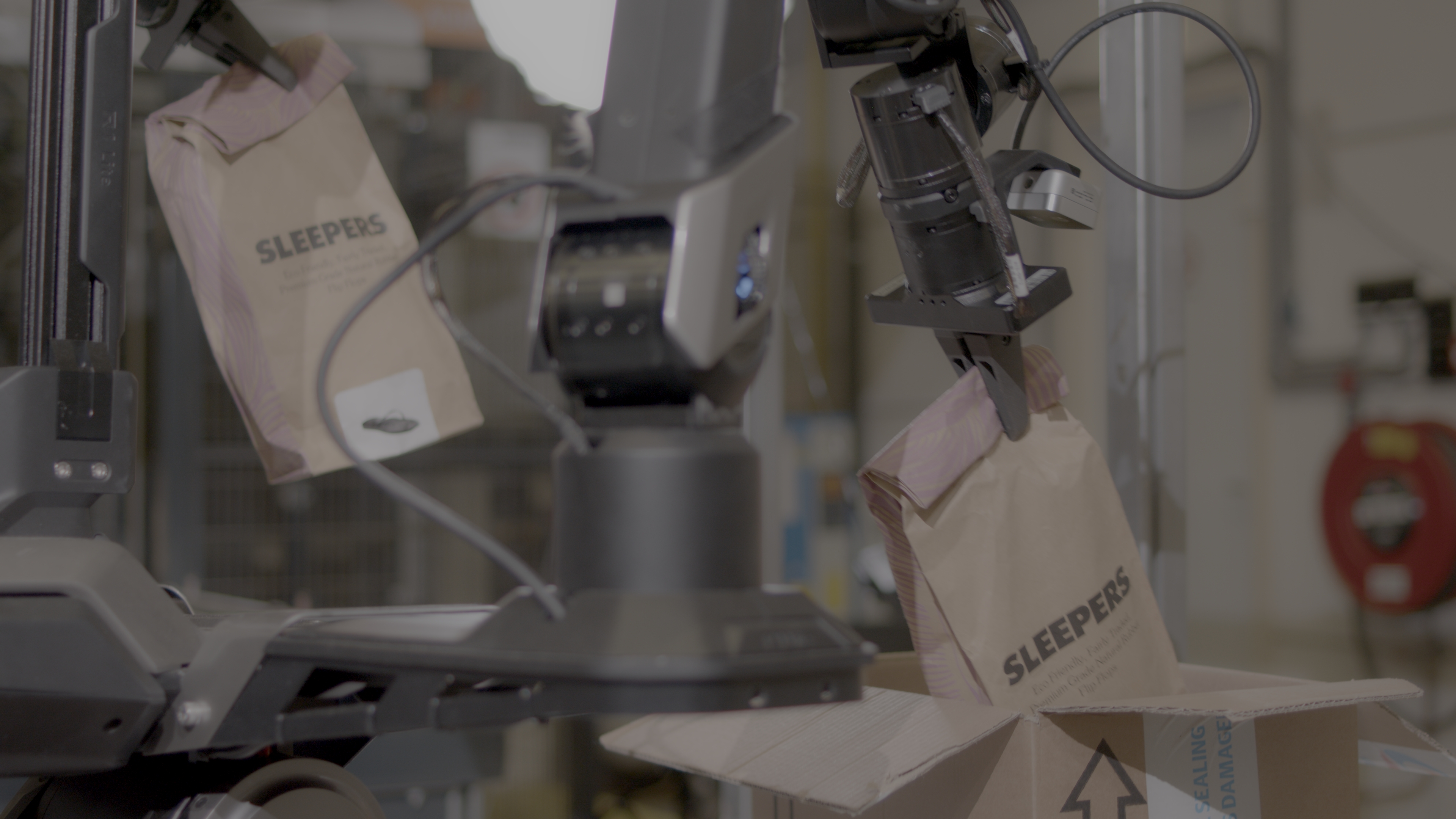
How AI warehouse robots learn
Traditional automation runs on rigid programming. New AI robots work differently. End-to-end AI gives robots the ability to see, understand, and act in one continuous loop.
What end-to-end AI means
End-to-end AI is a single neural network model. It takes raw inputs and produces motor actions directly. No separate modules for vision, planning, or control. One model handles everything.
This approach eliminates handoffs between systems. Fewer failure points. Faster reactions.
The three inputs
Every cycle, the AI model receives three types of information:
-
A prompt. The task to complete. “Pick up the box.” “Place on pallet.” “Sort by label.”
-
Vision. Multiple cameras mounted on the robot body capture the environment. The model sees what the robot sees.
-
Robot state. The current position and angle of every joint. The model knows where the robot is in space.
These three inputs feed into the model together. The model processes them as one unified stream.
The output: joint actions
The AI model predicts an action for each robot joint. Move this joint five degrees. Extend this arm segment. Rotate the wrist.
These predictions happen many times per second. Each cycle, the model receives fresh inputs and produces new actions. The robot moves in smooth, continuous motion.
The feedback loop
This creates a constant feedback loop:
- The model receives the prompt, camera images, and joint positions
- The model outputs joint actions
- The robot executes those actions
- New camera images and joint positions feed back into the model
- The loop repeats
The robot perceives, decides, and acts in one tight cycle. No waiting. No batch processing. Real-time adaptation.
Why this matters for warehouses
Traditional robots follow scripted paths. They break when objects move or environments change.
End-to-end AI robots adapt on the fly. The vision system detects changes. The model adjusts actions instantly. A box in a different position is not a problem. The robot sees and responds.
For 3PLs with changing products, layouts, and requirements, this adaptability is essential.
See end-to-end AI in action.
Book a live demo.
Watch our robots learn new tasks and adapt to your warehouse environment.
Learning new tasks
Teaching new tasks becomes straightforward. Show the robot what to do. The model learns from demonstration. No programming. No custom code.
The same model architecture handles picking, packing, sorting, and placement. You train new behaviors without rebuilding the system.
FAQs: end-to-end AI for warehouse robots
Three inputs: a task prompt, camera vision from the robot, and the current position of each robot joint.
The loop runs many times per second. Fast enough for smooth, continuous robot motion.
No. The model learns from demonstration. Show the robot what to do. Training takes hours, not months.
The vision system sees changes in real time. The model adjusts actions immediately. No reprogramming needed.
Yes. The constant feedback loop allows the robot to correct errors as they happen.
A simpler architecture
End-to-end AI removes layers of complexity. One model replaces separate vision, planning, and control systems. Fewer components mean fewer points of failure.
For warehouse operators, this translates to more reliable automation and faster deployment.